How a wind farm in the Eastern Cape is doing more than generating electricity
Published: 3 May 2026
Dambisa Zenani started her business the way many do: with very little, and a lot of determination. She washed clothes by hand, one at a time, building something from nothing in Joza Location, Makhanda. Today, Sis ‘D Laundry is a same-day service with three employees and a growing reputation in the community.
A few streets away, Sinethemba Leve was navigating a different kind of hardship. Retrenched during the COVID-19 pandemic, he used his savings to start a small water distribution business, responding to a real and pressing need: access to clean drinking water in Joza. Since then, his business has grown to five employees and secured supplier registration with Rhodes University.
These are not stories about wind energy. But they would not exist in the same form without it.
The link between a wind farm and a laundry business
Wind Garden, NOA’s 94.5MW wind energy facility near Makhanda in the Eastern Cape, has been in a year-long partnership with the Assumption Development Centre (ADC), a registered non-profit organisation established in 2014, focused on youth unemployment and socio-economic development in Joza.
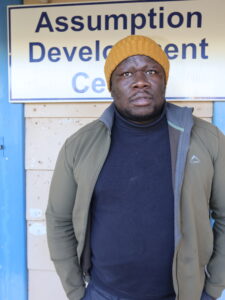
Masonwabe Nduna, Centre Manager at ADC. Image credit: Sizo Media
Through this partnership, Wind Garden has provided funding, equipment and services to ten small businesses in the area. The support is deliberate and locally informed. ADC knows this community well, and that local knowledge has been central to making the programme work.
“The capital investment provided to businesses has enabled them to scale their operations and reach new markets. Most importantly, three of the supported enterprises are now registered suppliers at Rhodes University, opening doors to more stable and larger-scale opportunities,” said Masonwabe Nduna, Centre Manager at ADC.
“Partnering with a locally based organisation like ADC has been invaluable and has allowed for more responsive and meaningful support. Their strong relationships and credibility within the community ensures that our assistance reaches businesses in a way that is both impactful and sustainable,” said Angela Harrison, Socio-Economic Development Manager at NOA.
Practical support that opens real doors
For Sinethemba, the turning point was an industrial-scale printer, funded directly by Wind Garden through the ADC. It was a specific, practical intervention that had a measurable effect.
“We can now print labels for the water bottles, with our clients’ branding. This has resulted in more revenue for the business and I have been able to increase my employees from three to five. We have even been able to register as a business supplier for Rhodes University and will be supplying water for some of its events soon,” he said.
Three of the ten businesses supported through the programme are now registered suppliers at Rhodes University, opening access to larger, more stable markets than many small enterprises in Joza would typically be able to reach.
For Dambisa, the combination of community support and targeted assistance gave her business both roots and room to grow.
“With the support of my family and organisations like the Assumption Development Centre, I was able to grow my business from hand-washing clothes to running a same-day laundry service. Today, I’m proud to employ three young people and support my family. This journey has shown me the value of perseverance and community support,” she said.
The ten businesses that received enterprise development support from Wind Garden include Sis ‘D Laundry, Bob’s Upholstery, Linear Detergents Multipurpose Primary Co-Operative, the Bill Kali Collective in partnership with StichLab, Jusaqua, Enhanced Aloe, Zeamo, Mamase Divine Holdings, TT Industries and Lu M Photography.
What this reflects about how NOA operates
Renewable energy infrastructure is, by necessity, built in places. It occupies land, draws on natural resources and becomes part of a local landscape, both physically and socially. For NOA, that proximity carries responsibility.
The Wind Garden–ADC partnership reflects a specific view: that meaningful community investment requires local expertise, sustained commitment and accountability for outcomes. Not a single donation or a once-off intervention, but a relationship built over time with organisations that understand the people they serve.
“Following a successful one-year partnership, we are excited to explore further enterprise development opportunities with the ADC in 2026 onwards,” said Harrison.
The energy that Wind Garden feeds into the grid powers businesses and industrial operations across South Africa. What it enables in Joza is something different but equally real: people building livelihoods, creating jobs for their neighbours and accessing markets that were previously out of reach.
That is what the transition to clean energy looks like, beyond the turbines and transmission lines.