Published: 25 February 2026
What an energy aggregator actually does, and why it matters for your business
As South Africa’s electricity market evolves, more commercial and industrial customers are encountering a player in the value chain that is yet to be fully understood: the energy aggregator.
It is also one of the most common questions we hear: “What does an aggregator actually do, and why would my business need one?”
The short answer is that aggregators help customers to navigate the complex, rapidly changing electricity market with confidence. And the details of the full value are worth unpacking.
1 Aggregators connect electricity buyers and generators
South Africa is in the midst of a structural shift in how electricity is produced, traded and consumed. The system is moving toward a multi-market structure supported by bilateral trading and a future wholesale market. In this emerging landscape, energy traders and aggregators play a practical bridging role between generators, networks and customers.
At its core, an energy aggregator enables commercial and industrial customers to access privately generated renewable energy through structured, long-term energy supply agreements, without needing to contract directly with individual projects or manage the complexity of the market themselves.
2 Aggregators combine multiple energy sources to match real demand
The defining function of an aggregator is exactly that: aggregation.
Instead of a customer contracting with a single generation plant, that may not match their load profile, risk tolerance or growth plans, aggregation allows energy from multiple generation facilities to be combined and optimised against real demand.
By blending different technologies, locations and production profiles, aggregators can shape a more consistent and usable energy supply. This portfolio approach reduces reliance on any single asset and creates solutions that are better aligned with how customers actually consume electricity.
3 Aggregators balance variable renewable supply and demand
Renewable energy is inherently variable. The sun does not always shine, and the wind does not always blow exactly when industrial demand peaks.
One of the key functions of an aggregator is portfolio management. By combining energy from different technologies (such as wind, solar and energy storage), from different regions, and allocated across multiple customers, an aggregator can smooth supply variability and improve overall reliability.
Karel Cornelissen, CEO of NOA, explains: “The real value of aggregation is not merely access to renewable electrons – it is the ability to shape, balance and deliver those electrons in a way that aligns with how customers actually consume energy. As South Africa’s market becomes more dynamic, that portfolio capability becomes increasingly important.”
4 Aggregators structure flexible, scalable energy solutions
Another important role aggregators play is enabling flexibility. Many commercial and industrial customers are entering private power procurement for the first time. Their load profiles may change, facilities may expand and decarbonisation targets may evolve. Aggregation allows energy solutions to scale and adapt more easily than single-asset contracts.
5 Aggregators help manage long-term cost and risk
Electricity is a material cost input for many South African businesses, in some sectors representing up to 40–50% of operating costs. At the same time, companies face increasing pressure to decarbonise while remaining globally competitive. By actively managing portfolios, contracts and delivery risk, aggregators help customers move beyond simple tariff comparisons toward fully delivered, risk-adjusted energy solutions.
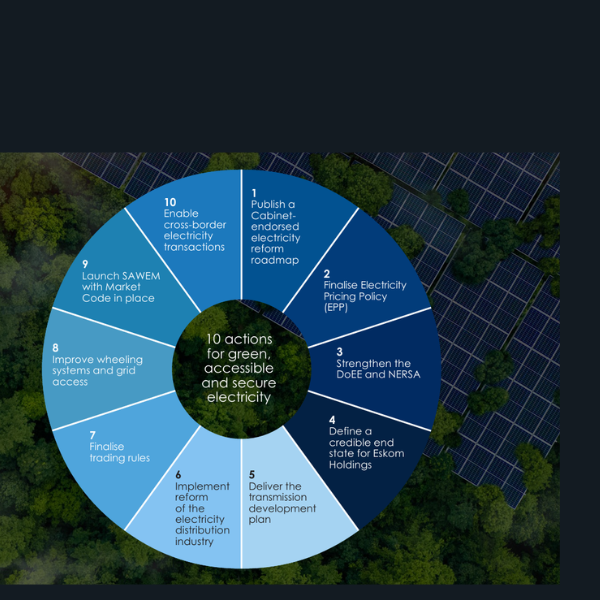
The Policy to Power report highlights that enabling competitive market participation will be critical to unlocking investment and delivering a resilient power system. Aggregation is already playing a role in that transition.
Why the right aggregation partner matters
Not all aggregation models are equal. As the South African market matures, customers are increasingly evaluating portfolio depth, technology diversity, geographic spread, balance sheet strength and execution capability.
At NOA, our focus is on building diversified generation portfolios and applying disciplined trading and risk management to deliver clean, predictable and flexible energy solutions. We believe the future electricity system will be increasingly portfolio-driven, data-enabled and customer-centric.
For businesses exploring private power, the key question is not only how much energy costs today, but how reliably and flexibly it can be delivered over the life of the energy supply agreement.
About the author: Christine Krone is Head of Marketing at NOA, bringing more than 20 years’ experience in technical and B2B marketing across renewable energy, financial services, higher education and consulting. She is passionate about demystifying complex industries and translating technical solutions into clear, compelling customer stories that help organisations make informed energy decisions.